Zion Trifecta

June 29, 2009 by Buzz

We’d been planning the Trifecta for over a year, and as of June 27, there is now one less amazing project in Zion National Park “undone”. Jared Campbell, Ryan McDermott, and I did the 3 biggest canyons in the Park in one day.

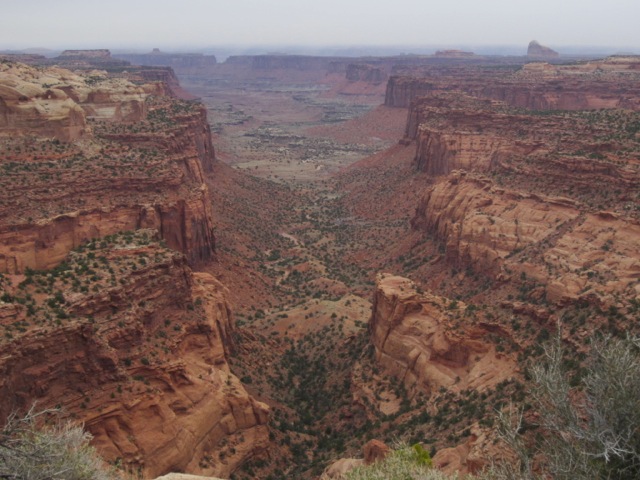
Zion is aptly called a “Sandstone Yosemite”. An appropriate name, but what “Yo” lacks, are the extremely narrow slot canyons deeply incised into the soft sandstone; they are often filled with cold water, are dark, and end in high vertical pour-offs above the main canyon bottom; an entire world apart, literally invisible until one finds and rappels into their depths.

Only in the last 10 years has the sport of canyoneering developed. Needless to say, the thought of not just doing them, but seeing how fast I could do them, entered my mind years ago. I’m way too old to win any trail races or set records on well known big routes, but age paradoxically has some benefits similar to those of youth: 1) You don’t try to fit in, and instead do what pleases you; 2) You can be a pain in the ass and your friends and family still tolerate you.

We’ll leave #2 alone; #1 is the aspect pertinent to this project.  Projects like the Trifecta, are like “Plucking the low-hanging fruit, located way far out on the limb.”

HeapSteep

Read the rest of this entry »

Thompson Peak, Trinity Alps

June 18, 2009 by pantilat

Topping out at just over 9,000 feet, Thompson Peak is the highest point in the Trinity Alps, which is a high section of the Klamath Mountain Range in northwestern California. The peak is at the headwaters of the most rugged drainage in the Trinity Alps, the Canyon Creek drainage, where several peaks rise above 8,800 feet. Due to the geographical location of these mountains, they contain elements of the Cascades to the north and Sierras to the south. Their height is not impressive when compared with the Sierras, but their higher latitude and proximity to the Pacific Ocean allow for significant winter snow accumulation and the existence of a few small glaciers.

Upper Canyon Lake with the Wedding Cake and Thompson Peak refecting

Upper Canyon Lake with the Wedding Cake and Thompson Peak refecting

I climbed Thompson Peak via the Canyon Creek trailhead in 9:42, starting at 6:20 am and finishing at 4:02 pm (4:52 to summit, 22 minutes on top, 4:28 return). The climb involved 16 miles of trail and nearly an equal amount cross country travel, entailing bushwhacking, routefinding, talus hoping, scrambling, and snow. A large portion of the trail was good for running, but none of the cross country travel was runnable. There was even some class 4+ exposed moves to ascend the final summit block. I found spectacular mountain scenery and a true wilderness feeling beyond Canyon Creek Lakes where there is virtually no evidence of human impact.

Gear:

  • La Sportiva Fireblade
  • Ultimate Direction Wasp Pack
  • Petzl Snowracer Ice Axe
  • Kahtoola Aluminum Crampons

The Trinity Alps, often overlooked by Mount Shasta, are a real gem and I plan on returning here for more climbs in the future. Check out many more photos and a complete trip report at CascadeClimbers.com.

50 Pitches In A Day

May 31, 2009 by Buzz

My hands are swollen; they feel like raw hamburger, and my feet are sore. Yesterday Bill Wright and I climbed 50 pitches in Eldorado Canyon. Our rules were that each route had to be rated 5.7 or above, and no pitches could be repeated. This involved doing 11 different routes, totaling about 5,000 vertical feet of technical climbing, plus the required scrambling, hiking, and rappelling to get off the tops and to the base of the next climb. It took 11 hours and 18 minutes.

“Hey wait a minute”, you might say. “This isn’t about running!”

You are correct. So let me explain:

What all this is about for me, is being in nature – moving, usually as quickly as I can – and preferably in the mountains or deserts. Although I’m well known as a runner, I actually don’t care what mode of movement I’m employing – running, backpacking, skiing, cycling, climbing, canyoneering – they’re all the same to me, they’re all good, and I just use whatever works best to get me to the places I want to be.

“Eldo” is one of those places I want to be. The dramatic and colorful lichen-flecked sandstone walls tower above the roar of South Boulder Creek, 800′ directly below. It’s a world-famous climbing area, and everyone from the local uber-jocks, to young couples, to climbers from out of state or country, engage in an intimate and intense dance with the natural environment, raising the energy level of the place so it’s like being at a rock concert with no sound.

Eldo

While I love the simplicity and purity of a race, I greatly prefer “projects”, because the personal attributes one must manifest in order to succeed are more broad and engaging. Instead of showing up at the specified time and date, and running the specified route at a specified pace, you have to bring a lot more of who you are to the table. One must: 1) Dream; 2) Plan; 3) Research; 4) Do Specific Training; 5) Commit; 6) Have Courage and Effort; 7) Drink a beer and write a blog post when you’re done.

I might or might not be kidding about that last one; but am not about this: the really key element that makes difficult projects go well is: #8 A Great Partner.

Especially for this project: Doing 50 PIAD (Pitches In A Day) in Eldo is both interesting and problematic, because one must scramble, rap, or hike off everything, and the topography is quite rugged and spread out, thus requiring a fair amount of stamina and strategy. It was going to be a long day. The best way to get this done, would be to “simul-climb” everything. This means instead taking turns with one person climbing while the other belays, both climbers move at the same time. We’re still roped together, and placing protective gear, but there are no active belays; if the leader falls, he could take a 50′ whipper, stopped only by the body weight of the follower on the rope, who would be pulled upward toward the placed gear. If the follower falls however, he would immediately pull the leader off also, and they both would plummet until the leaders falling body came to a very abrupt halt at the nearest gear placement below him.

So in simul-climbing, if the second falls, the likely result would serious injury or worse for the leader. If one person makes a mistake, both pay.

In climbing, possibly more than any other sport, #8, “Great Partner” is not just important. It keeps you alive.


Read the rest of this entry »

Call Of The Wild

May 27, 2009 by Buzz

Andrew Skurka embarks on major Alaska trip – - -

Ever since he was the first person to do the 7,778 mile long Sea-Sea route – Cape Gaspe to the Olympic Peninsula, which took 11-months including walking across the upper midwest in mid-winter – Andy has been one of the pre-eminent hikers in the country. He followed that post-college graduation monster with the Great Western Loop (6,875 miles around the west), the Sierra High Route (200 miles mostly off-trail) and a traverse across Iceland, besides spare-time casual hikes like the Colorado Trail and Pacific Crest Trail thru California.

So what’s next?

700 miles thru the Kenai Peninsula and Chugash Mountains of Alaska.

“About 1/4 of that will be on a pack-raft. Without a raft, this route is impossible” Andy says. “Then there’s maybe 100-150 miles on some kind of trail. That leaves 400 miles of bushwhacking.”

“The Kenai bushwhacks are heinous. Pushing thru bark beetle infested Spruce that blew down 5 years ago into a jungle-gym of fallen timber. The undergrowth is Devils Club and Salmon Berries. It might take me 6 hours to go just 2 miles.”

Sound like fun to you?

(There is a current report; see “UPDATE” at bottom of Post)

Andy3

Read the rest of this entry »

Upcoming Multi-Day Trail Record Attempts

May 21, 2009 by Buzz

The season is gearing up! Here are just a few of the Big Trail record attempts developing.

COLORADO TRAIL – David Horton

The professor emeritus of multi-day trail records is back! David set the record on the Appalachian Trail in 1991, followed up with the record on the Long Trail in 1999, and after a John Muir Trail attempt  aborted on the first day, became the first person to do a supported run on the Pacific Crest Trail, establishing in 2005 what is still fastest time.  (An excellent video called “The Runner” was made of this project). Last year David tried the biggest big trail of them all, the Continental Divide Trail, but abandoned after the first day, June 7, which went very badly.

This year he hopes to start in Denver at 6 am on July 4 and break Paul Pomeroy’s 2008 record 8 1/2 days later in Durango.  This timing would enable him to be on the Hardrock 100 course, a race he has won, when the race itself is taking place – the HR100 and CT courses are briefly the same.  That would be remarkable.

ct-map

Read the rest of this entry »

Roaming on Rogers

April 23, 2009 by zahan1

I had the great fortune of being invited to Roger’s Pass for a backcountry skiing trip this winter. Reed Finlay and I got to tag along with, Steve Romeo from www.TetonAT.com who was headed to the Cold Smoke Festival in Nelson, B.C. and then to Revelstoke.

We arrived in Nelson at the tail end of a 21 day high pressure spell that had left the surface snow wonderfully faceted. We knew it would not hold up well once new snow came, but for now it made for great skiing on all aspects.

img_0190
Reed climbs Ymir

After a few days in the Southern Selkirks we were ready to meet up with Greg Hill and friends in Revelstoke, and get down to business on Roger’s Pass. We headed north into a large storm system that put an end to the high pressure and low danger. The avalanche cycle we all expected started in force and we kicked off numerous small and medium sized avalanches on the McGill Shoulder.      

The going gets good

The going gets good

The next day dawned high and dry, and with Aaron Chance and Greg Hill ready to go, we headed to the top of the pass. The weather was spectacular and we had assembled an all star team of backcountry skiers, but we knew we would have to keep our energy in check as the buried facets and surface hoar were likely to be reactive today. As a few of us stuck our heads in the snow to see what was happening beneath the surface we witnessed the sure sign of a disaster, 2 ridges to the east, a large avalanche released as a group of skiers made their way across it. Greg, a former ski mountaineering champion employed his high speed transition and was off skiing towards the site of the accident. 

Read the rest of this entry »